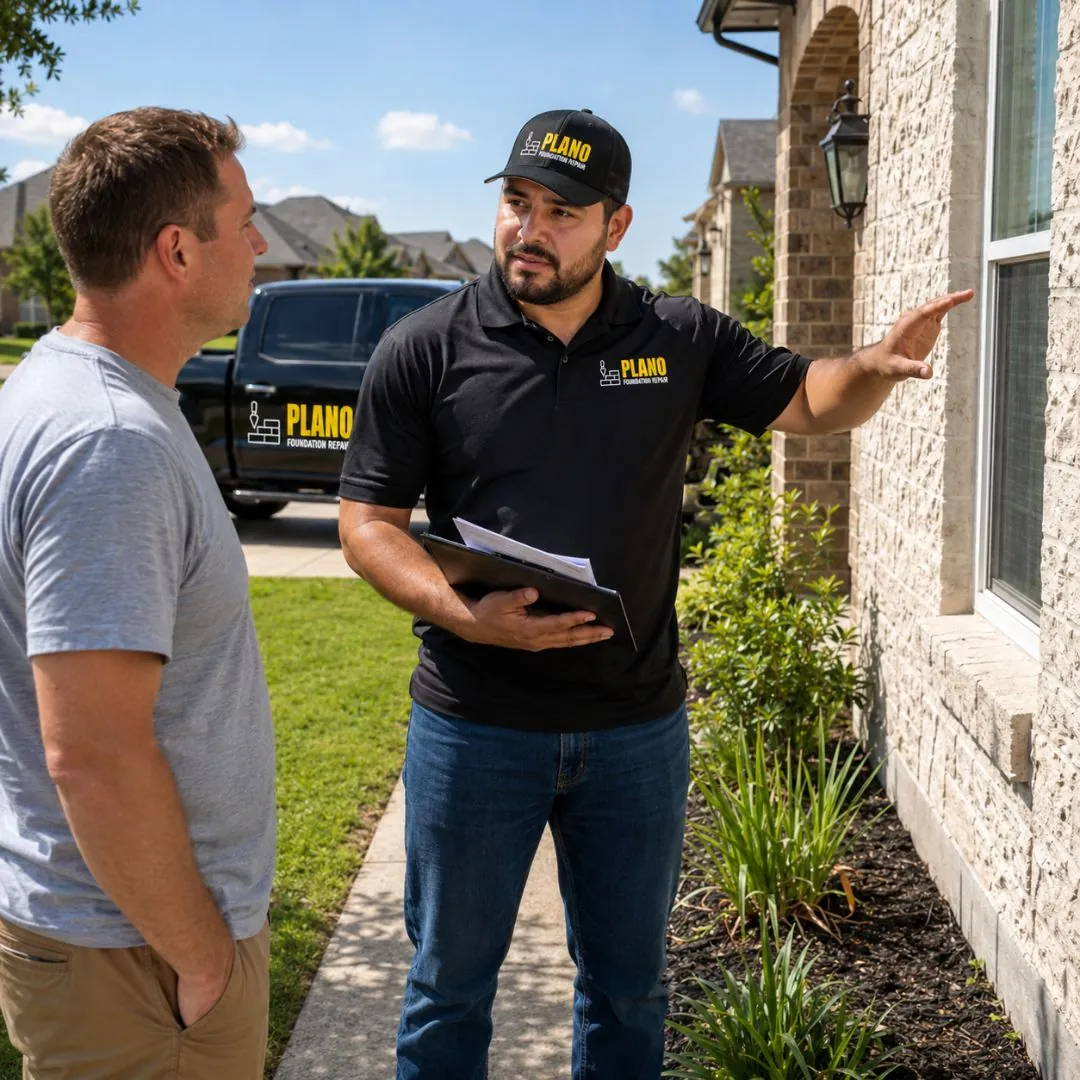
Foundation help for Richardson
Foundation Repair in Richardson
Discuss cracks, floor changes, or drainage concerns with our team.
Foundation help for Richardson
Discuss cracks, floor changes, or drainage concerns with our team.
Richardson contains many established homes with mature trees, aging drainage systems, remodeled interiors, additions, and a mix of slab and pier and beam construction. Over time, tree growth, plumbing changes, roof runoff, hardscape, and repeated wet-dry cycles can alter the soil conditions around a foundation.
Much of Richardson was built in the 1960s and 70s, and its mature trees, original plumbing, and mid-century slabs around the Telecom Corridor give it some of the most predictable foundation patterns in the metro.
Plano Foundation Repair evaluates visible symptoms along with the property's history and site conditions. We inspect accessible foundation areas, floors, doors, walls, masonry, crawlspaces, grading, downspouts, and low spots. Our services throughout Richardson include structural stabilization, slab and pier and beam repair, foundation inspections, crack repair, drainage correction, and soil stabilization. Reach out and we will schedule an evaluation.
Richardson has some of the oldest slab construction in this part of the metroplex. The city filled in largely through the 1950s, 1960s, and 1970s, which means a typical house here is a conventional reinforced slab that has been sitting on Blackland Prairie clay for fifty to seventy years. That age changes the most likely diagnosis in a way that matters.
Homes of that era were plumbed with cast iron drain lines running under the slab. Cast iron has a service life, and across North Texas those original lines are now well past it. A corroded line leaking under a slab saturates the clay in one localized area, and the resulting movement looks identical to ordinary soil settlement from the outside. The difference is that piering a house without fixing the leak means the soil keeps getting wet and the problem returns. In Richardson specifically, a plumbing static test before committing to structural work is worth the few hundred dollars more often than not.
The tree canopy compounds it. Sixty years of growth means large, established trees close to houses, drawing moisture unevenly from one side. Richardson joined the North Texas Municipal Water District in 1973 and drains largely toward Duck Creek and Cottonwood Creek.
Original drain lines from the 1950s to 1970s are past their service life. A static test before piering is the single highest-value diagnostic step in this city.
Long service on expansive clay. Movement is frequently real and correctable, but the cause has to be established before the scope is set.
Decades of root growth close to foundations. Uneven moisture draw from one side is a very common contributor here.

We consider aging materials, previous repairs, mature landscaping, additions, and decades of drainage changes.
Accessible supports, beams, joists, shims, and crawlspace moisture are reviewed when the property has raised-floor construction.
For concrete foundations, we evaluate settlement patterns, support needs, access, drainage, and reasonable adjustment limits.
We explain why drywall, masonry, tile, and paint repairs should often follow structural stabilization and monitoring.
We provide on-site service throughout Richardson. Contact us to arrange a visit.
Because of the housing age. Homes built in the 1950s through 1970s were plumbed with cast iron drain lines under the slab, and those lines are now past their expected service life. A leak saturates clay in one spot and produces movement indistinguishable from ordinary settlement. Underpinning without repairing the leak treats the symptom while the cause keeps working.
Typically $300 to $800, performed by a licensed plumber rather than the piering crew. Given that a partial perimeter of piers commonly runs $3,000 to $6,500, testing first is inexpensive insurance against repairing the wrong thing. Ask whether the test is included in the proposal or billed separately.
No. Concrete does not wear out on its own, and plenty of mid-century slabs here are performing fine. What changes with age is everything around the slab: plumbing corrodes, trees mature, grading settles, and drainage that worked in 1965 stops working. The slab is usually reacting to those changes rather than failing on its own.
Usually not. A mature tree that has been drying soil on one side for decades will stop doing so if removed, and that soil rehydrates and heaves, which can lift a corner and cause new damage. A root barrier installed between the tree and the house addresses the moisture draw without triggering that swing.
Before repairing the same crack again, find out whether foundation movement or moisture is contributing to it. One quick call is usually all it takes.
Quick, simple, and no obligation