Foundation help across North Dallas
Foundation Repair in North Dallas
Talk with our team about your property's foundation concerns.
Foundation help across North Dallas
Talk with our team about your property's foundation concerns.
North Dallas includes established residential streets, remodeled homes, townhomes, larger custom properties, and small commercial buildings. Mature trees, aging plumbing, additions, pools, extensive hardscape, and decades of drainage changes can all influence foundation behavior. Properties may have concrete slabs, pier and beam systems, or a combination of construction from different periods.
North Dallas neighborhoods from Preston Hollow to the High Five corridor mix estate lots, mature trees, and mid-century construction, a classic recipe for slow, seasonal foundation movement.
Plano Foundation Repair evaluates each building according to its construction and site conditions. We review cracks, floors, openings, masonry, crawlspace components, slab edges, grading, drainage, roof runoff, irrigation, and vegetation. Our services in North Dallas include foundation repair, slab and pier and beam work, inspections, crack repair, drainage correction, and soil stabilization. Reach out to schedule an evaluation.
North Dallas neighborhoods were largely established between the 1950s and 1970s, and the defining physical feature is the tree canopy. Sixty and seventy years of growth has produced very large, well-established trees sitting close to houses, and on expansive clay that is a first-order factor rather than a landscaping detail. A mature oak or elm draws a substantial volume of water from the soil during a Texas summer, and it takes it from one side of the property. The resulting moisture differential across a foundation is frequently the largest single contributor to movement in these neighborhoods.
The housing age brings the familiar mid-century pattern alongside it. Original cast iron drain lines beneath the slab are now past their service life, and a leaking line saturates clay locally in a way that mimics ordinary settlement. In North Dallas the two causes often coexist: a tree drying one side while a failing line wets another. Establishing which is dominant before setting the scope is the difference between a repair that lasts and one that reappears.
Property values here also mean independent engineer reports are more common than elsewhere, and that is generally a good thing. On a substantial home, paying for an assessment from someone with no stake in the repair is proportionate to what is at risk.
Decades-old trees close to foundations draw large volumes of water from one side. Often the dominant factor in these neighborhoods.
Original cast iron from mid-century construction is past service life. A leak mimics settlement and keeps the soil wet after piering.
A tree drying one side while a line wets another is common here. Establishing which dominates should precede any scope.
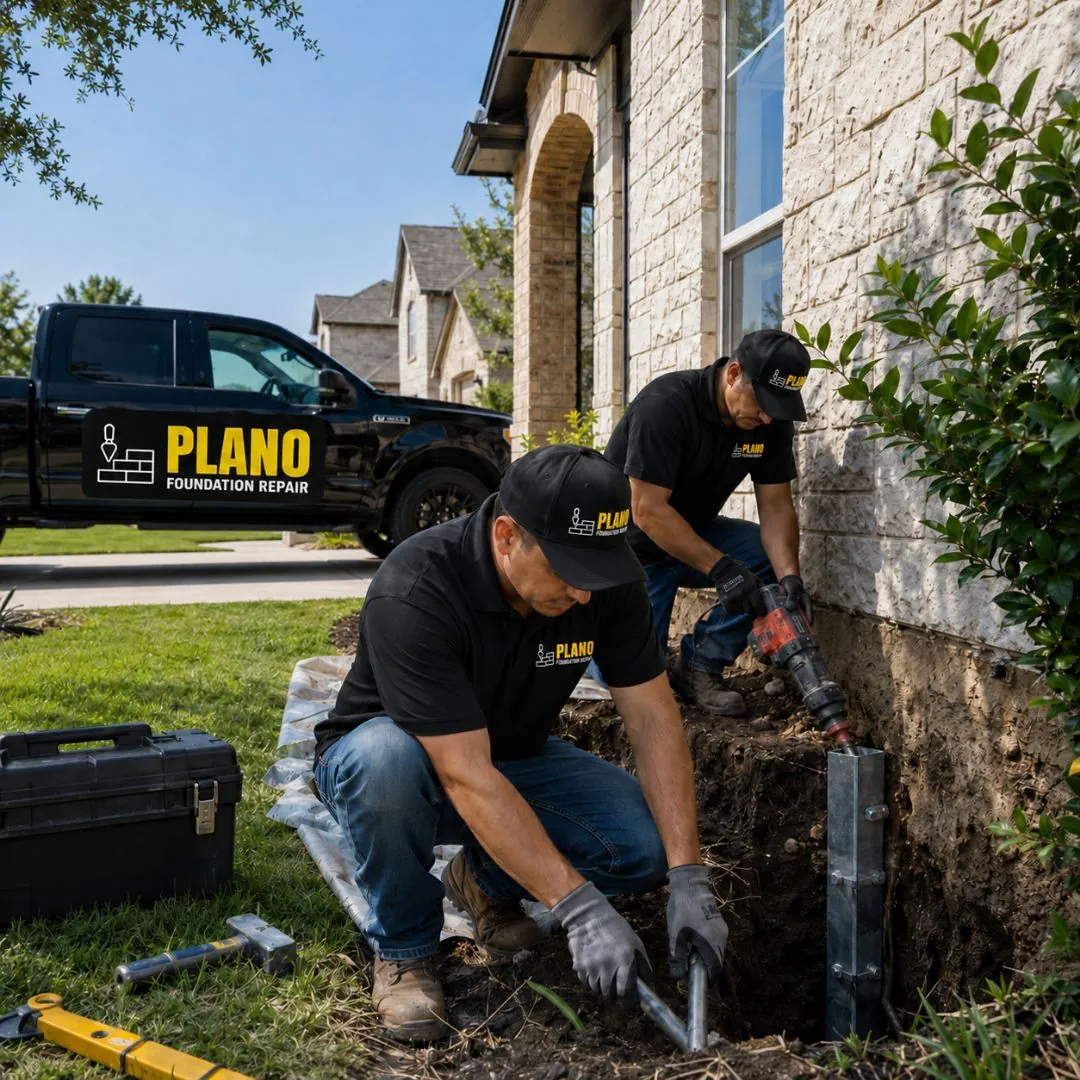
Additions, opened floor plans, changed loads, replaced flooring, and previous repairs are considered during the evaluation.
Large trees, dense planting, irrigation, roots, shade, and uneven drying may affect soil moisture around the structure.
We adapt the inspection and repair plan for slab, pier and beam, and mixed construction.
High-value flooring, built-ins, patios, pools, landscaping, and restricted work areas are discussed before the project begins.
Our team travels directly to homes and properties throughout North Dallas. Reach us through us.
They are often the largest contributor in these neighborhoods. A mature tree draws a significant volume of water from the soil during summer, and it does so on one side of a property. That creates a moisture differential across the foundation, which is the mechanism behind differential movement. The trees are not the whole story, but they are rarely irrelevant.
Usually not, and the reason surprises people. Soil a tree has been drying for decades will rehydrate once the roots stop drawing from it, and the resulting heave can lift a corner and cause damage comparable to the settlement you were trying to stop. A vertical root barrier between the tree and the house addresses the moisture draw without triggering that swing.
Frequently. Mid-century homes have original cast iron drain lines beneath the slab, and those lines are now past their expected life. A static test costs a few hundred dollars and can reveal that a leak, not the soil alone, is driving the movement. Piering over an unrepaired leak means the soil keeps getting wet and the problem returns.
Generally yes. A stamped report runs roughly $400 to $1,000 and comes from someone with no financial interest in the recommended work. On a substantial property, or where two contractors have given you conflicting diagnoses, that independence is worth the fee and gives you documentation that holds up in a transaction later.
Get a repair plan that considers the structure, site history, landscaping, and drainage around your North Dallas property. One quick call is usually all it takes.
Quick, simple, and no obligation