
Local help for shifting foundations
Foundation Repair in Plano, TX
Straight answers on what it costs, which method fits your soil, and whether you need work at all.
Local help for shifting foundations
Straight answers on what it costs, which method fits your soil, and whether you need work at all.
Foundation issues show up in a lot of ways: cracks above doors, uneven floors, separating trim, sticking windows, gaps along exterior walls, or brickwork that no longer lines up. Those signs do not all point to the same fix. Whether doors stick or won't close, floors pitch toward one corner, or diagonal cracks are climbing the brick, the pattern tells you something about what is happening underneath.
We start by looking at the whole property, including the foundation type, drainage patterns, soil conditions, visible damage, and how the structure is responding as a system. The goal is not to sell the largest project. It is to find the likely source of the movement, explain the choices honestly, and put together a repair plan that fits the building. If you are a homeowner who is not sure you need foundation repair at all yet, a short conversation is the fastest way to find out.
Most companies in this business will not publish numbers. Here is what the work actually tends to run locally, so you can judge a proposal before it lands in front of you.
Across Plano and the surrounding suburbs, the average residential foundation repair project sits near $5,000, and the middle of the market falls roughly between $3,500 and $6,800. The full spread is wider than that, from about $1,600 for limited work up to $15,000 or more when a large single-story home needs support along every side. Square footage matters less than you would think. What drives the number is how many support points are required, how deep they have to be driven before they hit resistance, and whether any of them sit under the interior of the house. The best foundation repair value is rarely the cheapest bid; it is the one whose scope you can actually verify.
| Scope of work | What it generally involves | Typical range |
|---|---|---|
| Crack sealing only | Epoxy or polyurethane injection, cosmetic patching | $500 to $1,500 |
| Partial perimeter piering | Six to ten supports along one settled corner or wall line | $3,000 to $6,500 |
| Full perimeter piering | Fifteen to twenty-five supports around the entire perimeter | $8,000 to $18,000 |
| Interior support points | Breaking through flooring or tunneling underneath to reach the center | Add $500 to $1,000 each |
| Pier and beam leveling | Shimming beams, replacing rotted posts, adjusting crawlspace supports | $2,000 to $7,000 |
| Drainage correction | Regrading, French drain, downspout extensions, surface drains | $1,500 to $6,000 |
| Plumbing static test | Pressure testing sewer lines running beneath the house | $300 to $800 |
Ranges reflect typical North Texas pricing and are offered for orientation only. Your actual number depends on the property and comes from the evaluation, not from a table.
When you compare foundation companies, the most useful question is not price. It is which approach they propose and what reasoning stands behind it. Comparing repair options side by side is the only way to see the difference.
| Method | How it works | Best suited to | Per point |
|---|---|---|---|
| Pressed concrete pilings | Cylinders hydraulically pressed down until they meet resistance, often 10 to 15 feet | The majority of local homes with ordinary movement | $300 to $500 |
| Pressed steel piers | Steel pipe driven considerably deeper, sometimes 25 feet or more | Deep unstable clay, heavier structures, repeat movement | $450 to $700 |
| Drilled bell bottom piers | Shafts drilled and poured with a flared base for bearing | Additions, crawlspace construction, heavier loads | $450 to $800 |
| Helical piers | Screw-type anchors torqued into the ground to a target resistance | Lighter structures, porches, tight access | $700 to $1,400 |
| Mud jacking or foam lifting | Grout or polyurethane injected to fill voids and raise concrete | Sunken driveways, garage floors, patios, voids under concrete | Priced by area |
Steel piers are the more expensive option, and they are not automatically the better one. On a home with average movement over moderately deep clay, pressed concrete does the same job for less. The mud jacking process is a different tool entirely: it lifts flatwork and fills voids, but it does not carry structural load the way a pier does. Any repair method worth paying for should come with a reason it was chosen. A contractor who recommends the same system on every property is describing a product line, not your building.
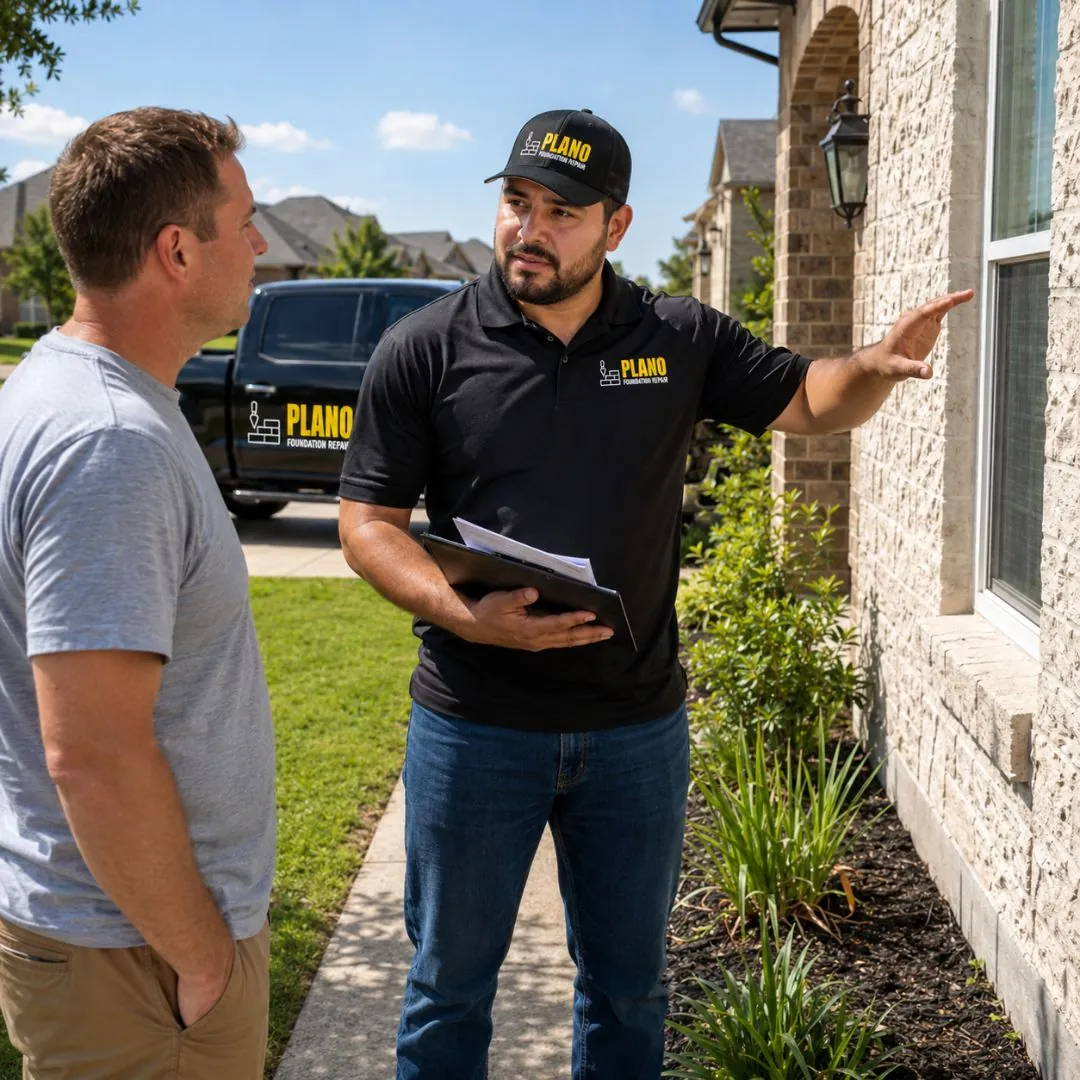
The clay soil running under this part of the state behaves like a sponge. It absorbs spring rain and swells, then shrinks hard through July and August. That swell and shrink cycle, driven by Texas weather more than anything else, is behind most foundation movement across Collin County and Denton County. The soil type under one lot can differ from the lot next door, which is why two Plano homes on the same street can age very differently.
Moisture levels rarely change evenly. A mature live oak pulls water from one side of a yard while a downspout dumps it against another. North of Dallas, where a lot of neighborhoods were built quickly on cut and fill lots, the ground under a single foundation can dry at different rates from one corner to the next. That difference, not the movement itself, is what cracks brick and tilts floors. It is also the reason good recommendations start with drainage and soil behavior instead of a preset package of piers.
One of these on its own usually means little. Three or four appearing together, or any one of them getting worse across a season, is worth an inspection. Addressing foundation issues early almost always costs less than waiting a year.
Diagonal cracking following the mortar joints, most often near corners and above windows. Width matters more than length, and anything past a quarter inch deserves a look.
Interior doors dragging at the top corner, or exterior doors that suddenly need a shoulder. Latches that no longer line up point to a frame that has racked out of square.
A marble rolling consistently toward one corner, or visible dips near a hallway. Unevenness across a room is a clearer indicator of foundation settlement than any single crack.
Cracks running at an angle from the corners of doors and windows, and seams reopening after being patched more than once.
Baseboards pulling away from the wall, crown molding opening at the miters, and gaps between brick and window frames where caulk keeps splitting.
Separation where a porch or patio meets the house, a chimney leaning slightly away, or soil pulled back from the edge leaving a visible gap. Exterior foundation cracks often appear here first.
Our services cover the structural, drainage, and soil factors that commonly contribute to movement in North Texas.
Practical plans based on your structure, soil, drainage, and visible movement.
Learn more →Solutions for concrete settlement, uneven support, cracks, and soil-related movement.
Learn more →Work on crawlspace supports, beams, joists, shimming, moisture damage, and uneven floors.
Learn more →A clear evaluation of symptoms, movement patterns, drainage, soil behavior, and practical next steps.
Learn more →Evaluation and options for concrete, masonry, drywall, and structural cracks.
Learn more →Drainage corrections and soil-focused improvements that help manage moisture around the structure.
Learn more →Knowing the sequence makes it much easier to tell a thorough proposal from a thin one.
Elevation readings are taken room by room, exterior grading and drainage are walked, and visible damage is documented. You should receive the readings, not just a conclusion.
Drainage, tree roots, a suspected plumbing leak, and prior work all get weighed. A static test may be recommended first, because a leak beneath the house changes the plan completely.
A diagram showing where each support point goes and why, the method chosen, the depth expected, the price per added point, and what is excluded.
The city requires a permit for structural work. The contractor pulls it. An engineer report is sometimes included and is worth requesting on larger projects.
Access holes are dug, supports are driven to refusal, and the structure is raised in measured increments while elevations are rechecked. Most homes take two to four days.
Post-lift elevation readings, backfill and cleanup, a follow-up plumbing test where appropriate, and the written warranty in your hands.
Many established foundation repair companies back structural work with a lifetime transferable warranty that carries to the next owner. Others offer a lifetime warranty that stops with you, which is worth knowing before you compare two bids side by side. Ask what the document actually covers, too. Most cover only the support points that were installed, which means a section of the house that was never underpinned is not included.
Beyond that, a few questions separate a genuine foundation repair expert from a salesperson: Why this approach for my soil? How deep do you expect to go, and what happens if you hit resistance early? What does one more support point cost? Is a plumbing test included? Who pulls the permit? What happens to my landscaping and my flooring? A repair contractor with real experience with concrete and crawlspace structures answers all of that without hesitating, and will tell you plainly when a property does not need repair yet.
More about usFoundation work stabilizes what has already moved. Managing water around the perimeter is what keeps the next problem from starting. Consistency is the whole idea: soil that stays evenly damp does not swell and contract as violently as soil that swings between soaked and baked.
A soaker hose set 18 to 24 inches out from the foundation edge, run on a short regular schedule through dry spells, does more good than occasional heavy watering. Keep grading sloped away from the house, extend downspouts well clear of the edge, and keep large trees from pulling moisture out from directly beside a wall. Where water still collects, correcting drainage is usually cheaper than adding piers later.
We provide foundation repair services in Plano and the surrounding communities, including Allen, Frisco, McKinney, Richardson, Murphy, Parker, Lucas, Wylie, Sachse, Garland, Carrollton, The Colony, Addison, Prosper, and North Dallas. Homes and businesses across the area sit on different soil, grading, construction ages, and drainage situations, so we evaluate each property on its own conditions rather than applying one recommendation everywhere.
We are a service-area business, so the team travels directly to you. Whether you are looking at a wall crack in a newer build, movement in one of the older homes near downtown, or a pattern that has developed slowly across several seasons, reach out to talk through your foundation needs.
See all service areas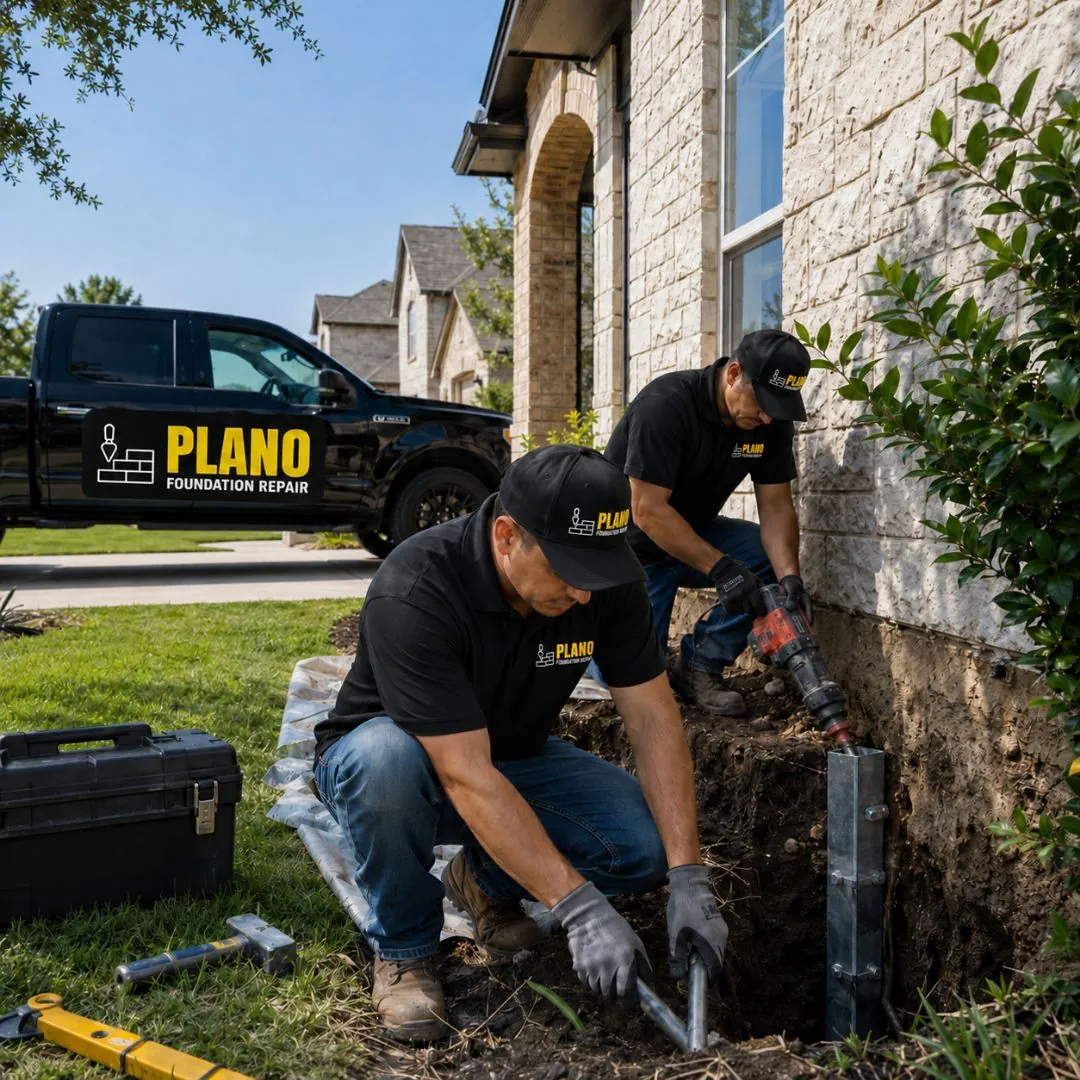
We look at the structure, drainage, grading, and surrounding soil before discussing options. The recommendation follows the property rather than a preset package.
The terminology gets confusing fast. We explain visible signs, likely causes, the choices in front of you, their limits, and what happens next in ordinary language.
The crews we work with handle expansive soils, hot summers, long dry spells, heavy storms, mature trees, and the varied construction types found across Collin County.
Concrete slab systems and crawlspace structures each need a different approach to access, support, adjustment, and moisture control. We evaluate and repair both.
Standing water, negative grading, and concentrated downspout discharge all contribute to movement. Those conditions get considered alongside the structural work.
Communication is coordinated from the first call, while field crews focus on access, protection, cleanup, and keeping disruption contained.
Repairing foundation damage in Plano typically runs between about $3,500 and $6,800, with an overall average near $5,000. Small crack work can run under $1,500, while a full perimeter of piers on a larger home can pass $15,000. Pricing is usually driven by the number of support points, how deep they have to go, whether interior access is needed, and the method chosen. Any figure quoted before someone has looked at the structure is a guess.
Usually not. Standard Texas policies exclude damage caused by expansive soil, settlement, and normal earth movement, which covers most of what happens here. Coverage is more likely when the movement traces back to a sudden covered event, such as a plumbing leak beneath the house. Because the cause matters so much, a plumbing test is often worth doing before a claim is filed. Read your own policy and speak with your carrier.
Common warning signs include diagonal cracks in brick or mortar, drywall cracks running from door and window corners, doors that stick or will not close, floors that pitch toward one corner, separated trim and baseboards, gaps where brick meets a window frame, and cracks in a garage floor or patio. One sign alone rarely means much. The pattern across the whole structure is what matters.
A typical residential job runs two to four working days. Ten to fifteen exterior support points on a single-story home can often be finished in a day or two. Interior work, tunneling, plumbing tests, or heavy rain can extend the schedule. Drainage corrections are usually a separate day of work.
In most cases yes. Exterior piering happens outside, and the home stays usable. You should expect noise, equipment in the yard, and soil piles near the work area. If interior support points are needed, sections of flooring get opened up and those rooms are off limits for a few days. Water may be shut off briefly during a plumbing test.
Work is done year round here, but late winter and early spring are often easiest. Soil moisture is more even then, so elevation readings are more representative of normal conditions. Repairs during a hard summer drought are common and perfectly workable; the crew simply accounts for soil that has shrunk away from the structure.
Documented, warrantied work generally helps more than it hurts. Buyers here expect to see some movement on houses of a certain age, and paperwork showing the problem was handled properly reassures them. Unrepaired movement, or work with no documentation and nothing standing behind it, is what tends to cost you at closing.
The service itself is legitimate, but the industry does contain companies that recommend more support points than a structure needs. A meaningful share of homes evaluated turn out to have cosmetic issues rather than active movement. Protect yourself by getting elevation readings in writing, asking why each support location was chosen, and comparing at least two proposals for the same scope.
Ask what approach they propose and why it suits your soil, how deep the supports will go, how many are included and what an added one costs, how long the coverage lasts and what it excludes, whether a plumbing test is included, who pulls the permit, whether an engineer report is included, and what happens to landscaping and interior finishes.
Consistency matters more than volume. A soaker hose roughly 18 to 24 inches out from the perimeter, run on a regular short schedule during dry spells, keeps soil moisture steadier and reduces the shrink cycle that pulls support away from the edges. The goal is evenly damp soil, not saturated ground, since heavy watering against the structure creates its own problems.
No. Hairline shrinkage cracks in concrete are normal and often need nothing. Location, width, direction, and whether the crack is changing over time matter more than its presence. Horizontal cracks, diagonal cracks wider than about a quarter inch, and cracks that keep growing deserve attention. Marking it with a dated pencil line is a simple way to see whether it is still moving.
Most of the correction happens during the lift itself. Minor adjustment continues over the following few weeks as soil recompacts around the new supports. Because of that, cosmetic work such as drywall patching, tile, and paint is usually best left for three to four weeks after the crew finishes.
Some cracks tighten noticeably during the lift and others do not. Structural work is intended to restore support and stop movement, not to refinish surfaces. Drywall, masonry, tile, trim, and paint are handled separately afterward, which is why cosmetic repairs are scheduled once the structure has stabilized.
A static test before the work identifies leaks that may be the actual cause of movement, which can change the whole plan entirely. A test afterward confirms that the lift did not stress a line. Many projects include both. Plumbing evaluation is performed by a licensed plumber, not the piering crew.
It typically covers the support points that were installed, meaning the company returns to adjust them if those locations settle again. It does not usually cover areas of the structure that were never supported, cosmetic finishes, plumbing, or drainage. Ask for the written document and read what is excluded before signing.
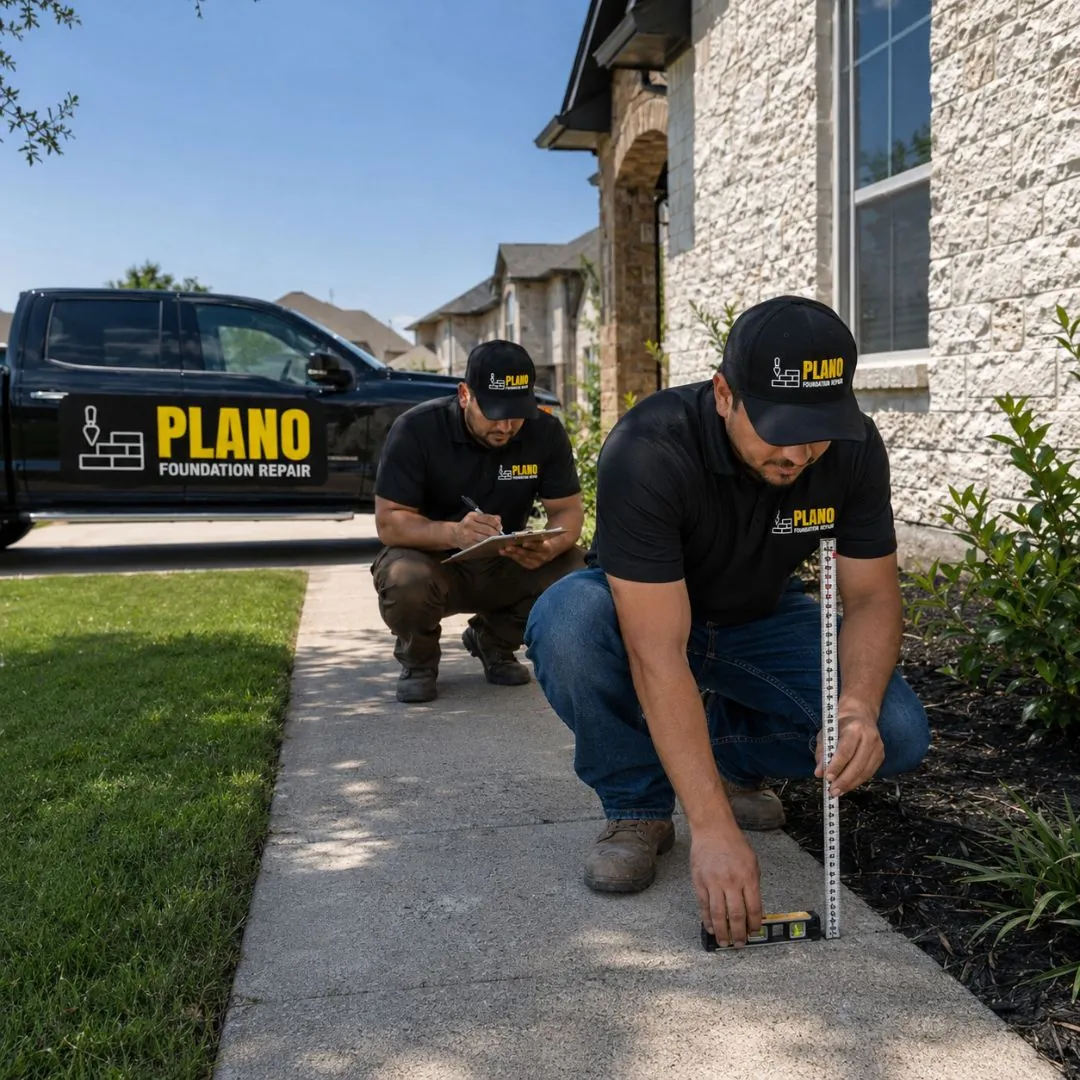
Not sure whether what you are seeing is structural, cosmetic, or a drainage issue? Start with an evaluation and a clear conversation about the property. One quick call is usually all it takes.
Quick, simple, and no obligation